
Crawl Space Vapor Barrier in Newport Beach, CA
A crawl space vapor barrier is a reinforced polyethylene sheet installed directly on the soil floor – and sometimes across the foundation walls – of your crawl space to block ground moisture before it migrates into your home’s structural wood, insulation, and living space. In Newport Beach, most vapor barrier installs run between $1,200 and $3,800 depending on square footage, existing moisture damage, and whether the crew needs to remove deteriorated materials first. Most jobs are completed in a single day.
If you’re seeing condensation on your floor joists, smelling something musty in rooms above the crawl space, or watching your hardwood floors shift with the seasons, those are signs the ground moisture is already winning. Our crew at Topside Attic Insulation Newport Beach handles vapor barrier installation as a standalone service and as part of full Crawl Space Encapsulation & Vapor Barrier in Newport Beach scopes. Either way, every job starts with a written price – no work begins without it – and closes with a documented photo record of what we found and what we installed. Call us at (657) 261-8265 to schedule a free on-site estimate.
Why Newport Beach Crawl Spaces Are Particularly Vulnerable
Newport Beach sits at sea level or just above it across most neighborhoods – Balboa Island literally sits in the bay – and the marine layer that blankets the coast from late spring through early summer keeps ambient humidity elevated for weeks at a time. That moisture doesn’t just hang in the air; it wicks up through bare soil in crawl spaces and condenses on any surface cooler than the dew point. In older homes in Corona del Mar and along the Balboa Peninsula, we regularly pull out vapor barriers that were installed decades ago with a 4-mil sheeting that simply wasn’t rated for the sustained humidity load Newport Beach sees.
The clay-heavy soils in parts of Newport Heights and the lower elevations near Newport Bay retain water longer than sandy coastal soils, meaning ground moisture release continues well past the rainy season. A crawl space that felt dry in June can show visible condensation on joists by August when nighttime temperatures drop and the marine layer rolls in. That cycle – wet, dry, wet – is harder on structural wood than sustained moisture alone because it accelerates the wood’s expansion and contraction.
This is the local context that shapes how we specify vapor barriers here. We’re not pulling specs from a generic national template. Newport Beach conditions call for heavier-mil sheeting, sealed overlaps, and in many cases, a full perimeter seal to the foundation wall rather than just a ground cover.
When You Need a Crawl Space Vapor Barrier
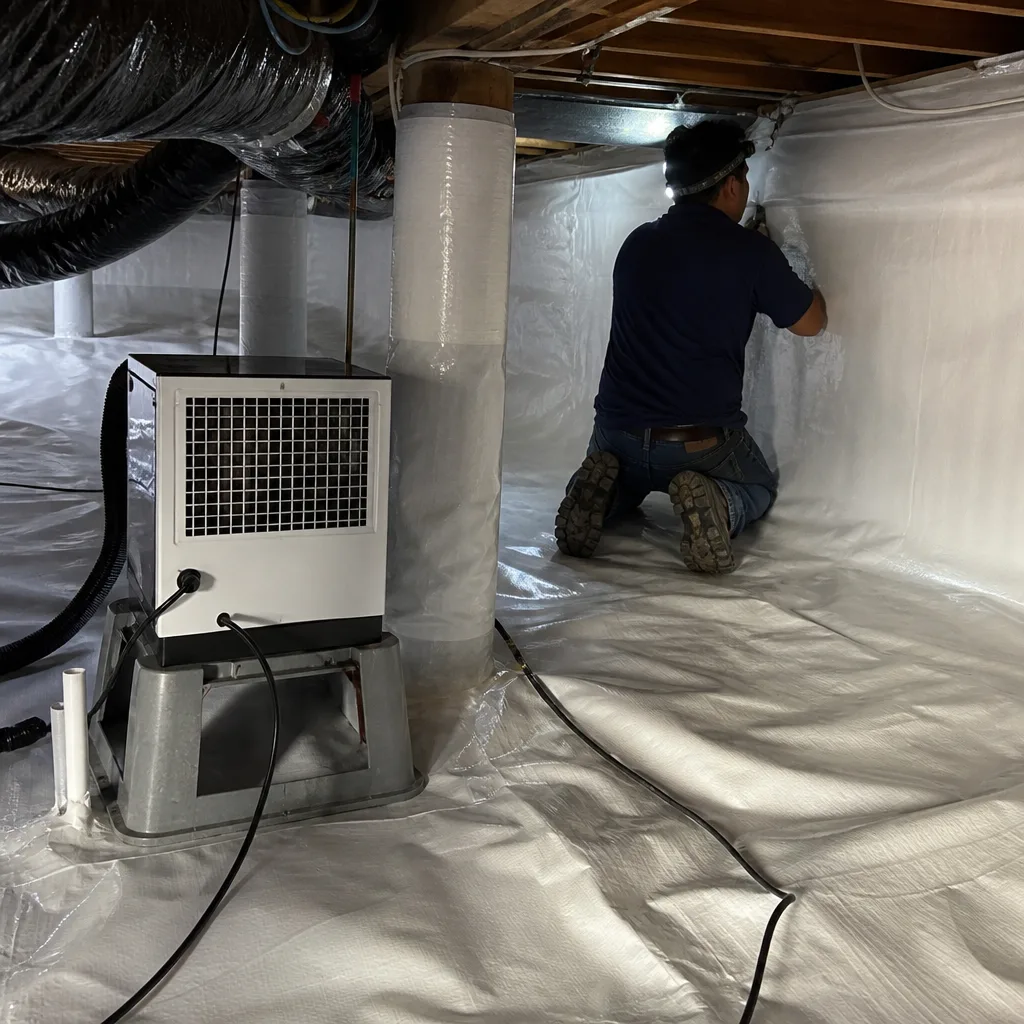
- Musty or earthy odors coming from floor vents or first-floor rooms. Ground moisture evaporating through an unprotected crawl space carries organic compounds upward through the stack effect – the natural air movement from crawl space through living area to attic. By the time you smell it upstairs, the moisture has been active long enough to begin conditioning wood fiber for mold growth.
- Hardwood floors cupping, buckling, or showing seasonal gaps wider than 1/8 inch. Wood flooring is extremely sensitive to relative humidity below it. Joists absorbing ground moisture swell and transmit that movement upward. In homes near Lido Isle and the Balboa Peninsula, we see this pattern frequently in older construction with no vapor retarder at all.
- Rust on metal components in the crawl space – straps, hangers, ducts, pipe connections. Rust on steel that’s only a few years old is a reliable humidity indicator. Steel oxidizes quickly when relative humidity stays above 70% for extended periods, which is common in unsealed Newport Beach crawl spaces during marine-layer months.
- Existing vapor barrier that is torn, bunched, or covered in biological growth. A damaged barrier is often worse than no barrier because it creates pockets where moisture accumulates without evaporating. If the current sheeting is less than 10-mil, visibly degraded, or missing seam tape, it needs to be replaced rather than patched.
- Recent pest or rodent activity in the crawl space. Rats, mice, and subterranean termites are drawn to the warmth and consistent humidity of an unprotected crawl space. After pest treatment, a new vapor barrier eliminates the moisture environment that attracted them. We regularly coordinate installs after pest remediation in the Newport Heights and Eastbluff neighborhoods.
- A home energy audit that flagged elevated crawl space relative humidity or cold floors in winter. If a blower-door test – a pressurization reading that shows, in one number, how much air your building envelope is losing – identified the crawl space as a significant infiltration zone, vapor control is one of the first physical corrections to make before addressing insulation above it.
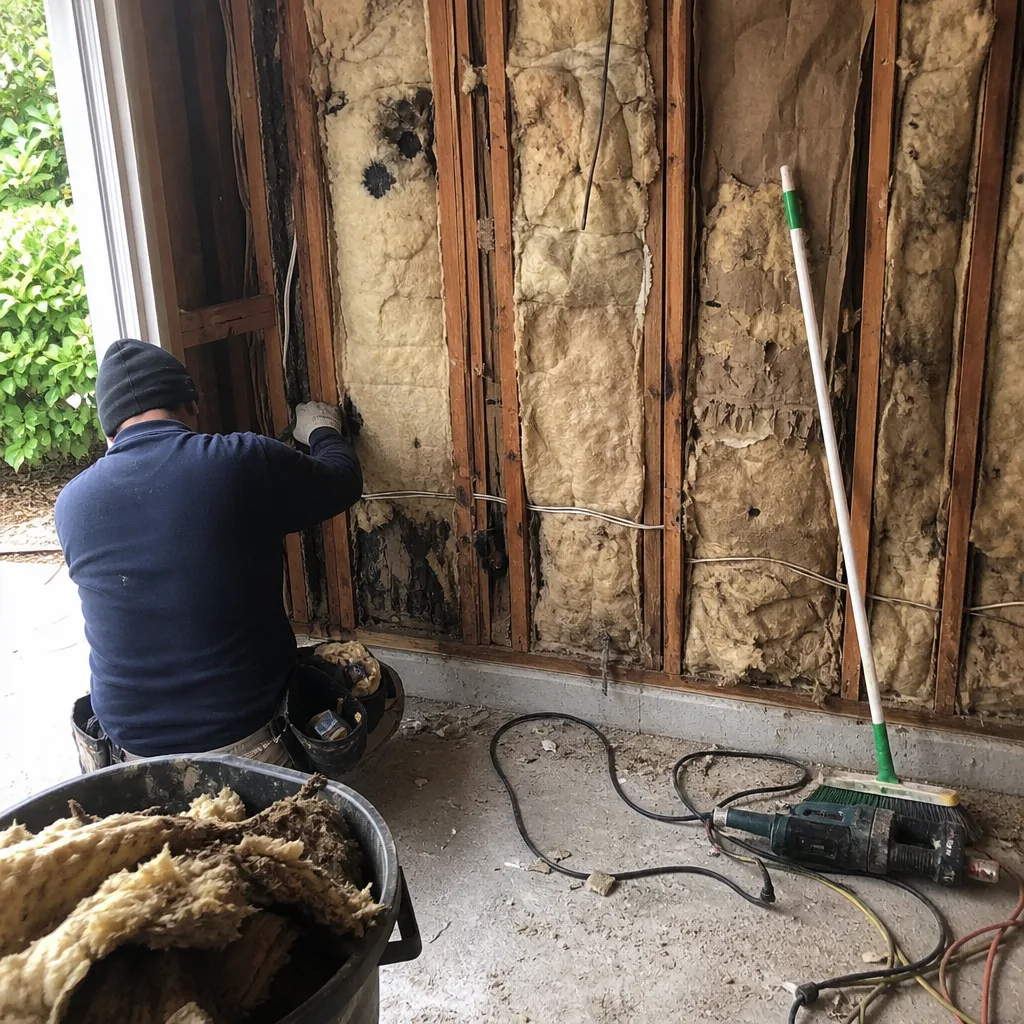 Before
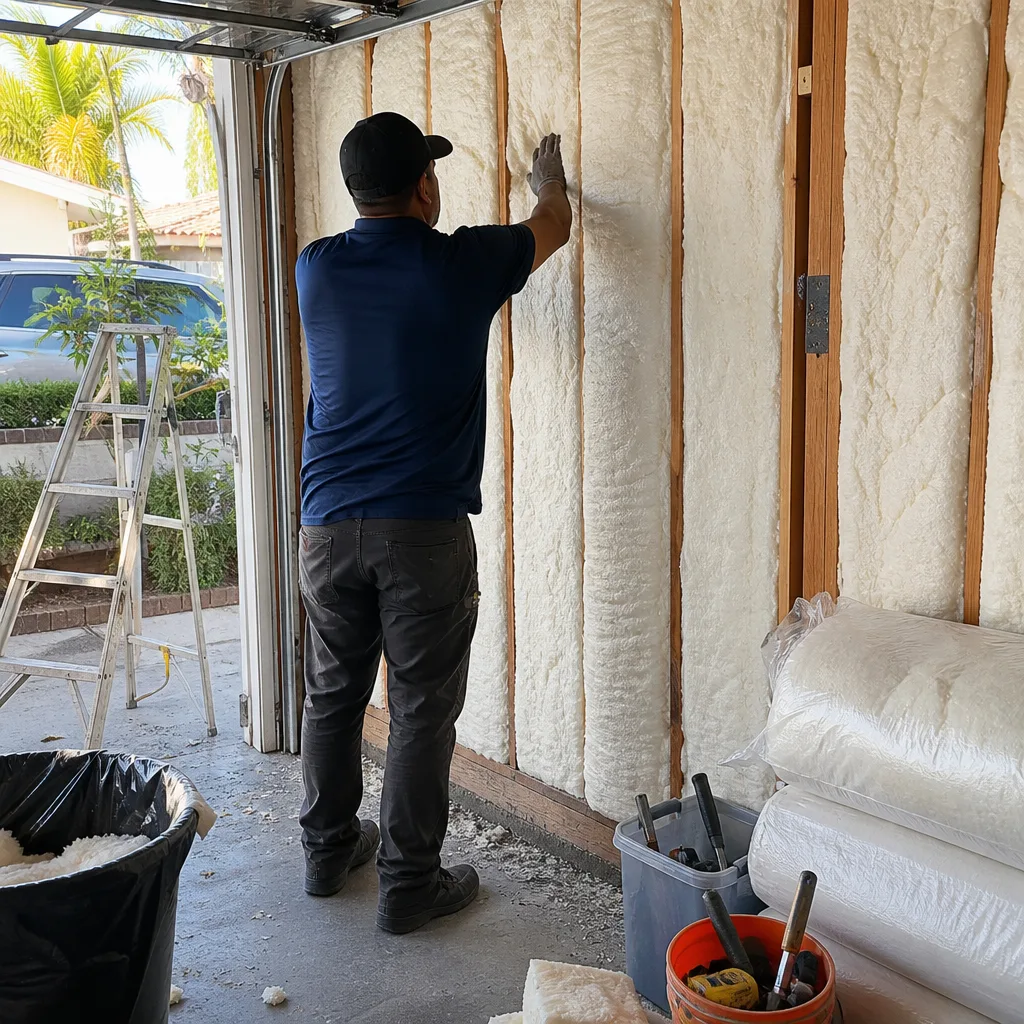 After
AfterOur Crawl Space Vapor Barrier Process
- On-site assessment and written scope. Before any material is ordered, Wes Okafor or a technician from our crew enters the crawl space and documents existing conditions with photographs: current sheeting condition, visible moisture or biological growth, joist condition, vent placement, and linear footage of foundation wall. You receive a flat written price and a written scope before anyone starts. That’s Haven Standard Clause 1, and it’s not optional on any job we run.
- Remove deteriorated materials. If existing sheeting, insulation batts, or debris need to come out, they’re bagged and hauled before new material goes in. Installing over damaged material is one of the most common shortcuts in this trade – it traps whatever is growing underneath and creates a measurement problem if you ever need to file an insurance claim on moisture damage. We document what we remove with photos.
- Prepare the soil surface. Rocks, sharp debris, and organic matter are cleared. A smooth surface matters because vapor barrier integrity depends on continuous contact with the ground. Punctures from debris underneath are the primary failure mode in sheeting that’s less than 12-mil.
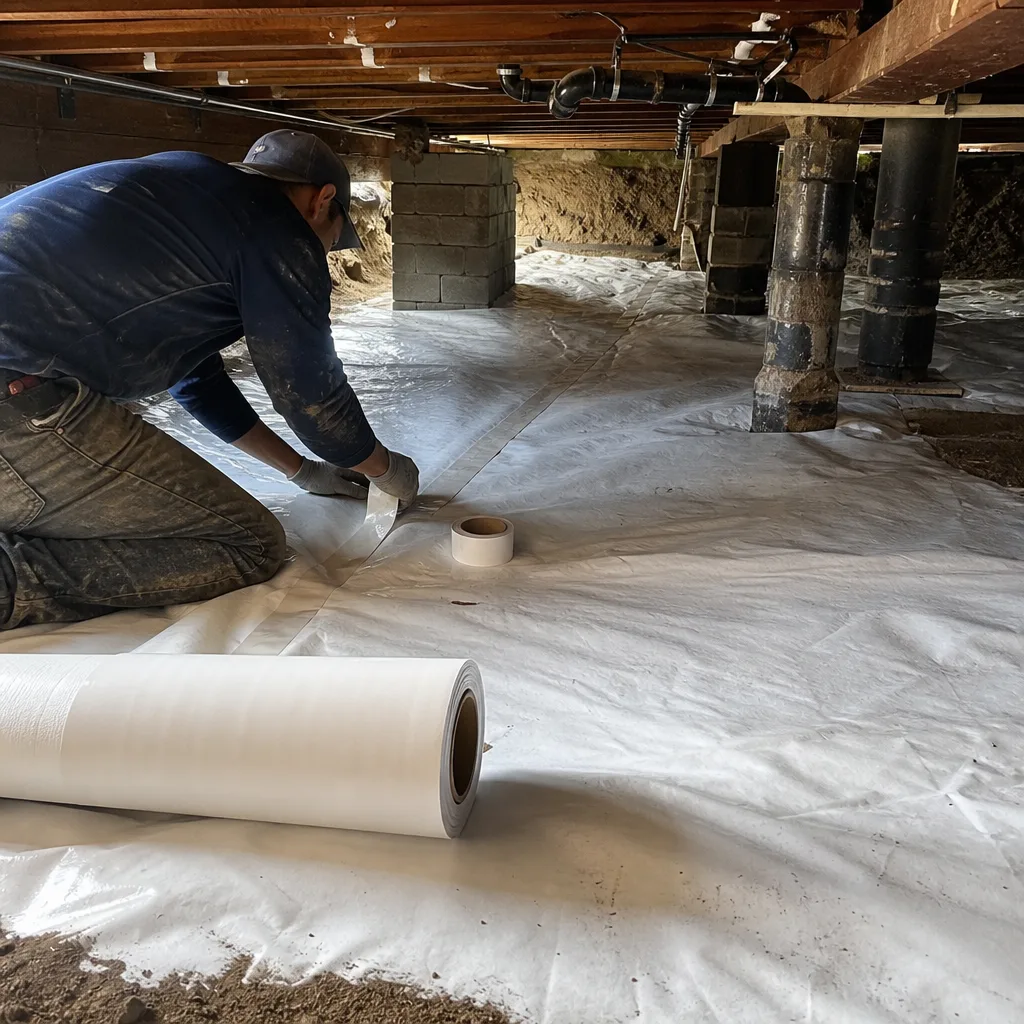
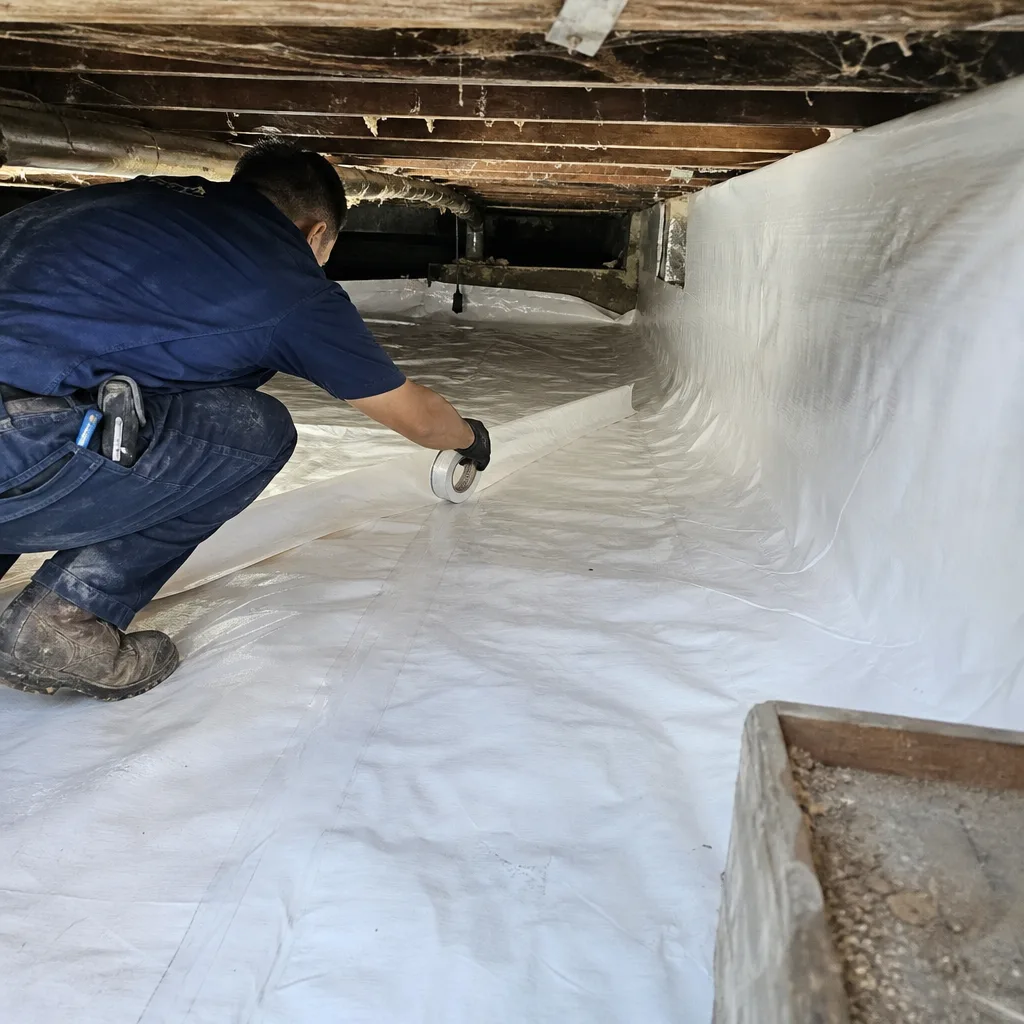
- Install reinforced polyethylene sheeting – minimum 12-mil for Newport Beach conditions. We run sheets in overlapping courses, with overlaps of at least 12 inches sealed with manufacturer-rated tape. We use CertainTeed’s vapor retarder products on most residential installs because the material specs are well-documented and the seam-tape adhesion holds in humid conditions. Sheets are cut to run up the foundation wall by at least 6 inches, then secured with masonry fasteners and a second tape seal at the wall junction. This perimeter detail is where most budget installs cut corners, and it’s where moisture re-enters.
- Inspect all penetrations. Pipes, columns, and support posts that pass through the barrier are individually wrapped and sealed. A vapor barrier with unsealed penetrations is only partially effective – ground moisture finds the path of least resistance, and unsealed pipe boots are an obvious one.
- Final documentation and walkthrough. The crew photographs the completed installation: seam tape, wall termination detail, penetration seals, and a full-coverage shot showing the finished ground cover. You receive the documented photo record before we leave the driveway. The 365-Day Done Right Promise applies from the job completion date – if anything we installed fails or was done incorrectly, we make it right.
Crawl Space Vapor Barrier Pricing in Newport Beach
Most homeowners in Newport Beach spend between $1,200 and $3,800 on a vapor barrier installation. That range reflects the actual spread we see across real jobs here – not a national average. Here’s what moves the number:
| Factor | Typical Impact on Price |
|---|---|
| Crawl space square footage (under 800 sq ft vs. 1,500+ sq ft) | $400-$900 difference |
| Old material removal and haul-away | $200-$600 depending on volume |
| Sheeting thickness upgrade (12-mil to 20-mil) | $150-$400 depending on coverage area |
| Perimeter wall seal vs. ground-only install | $300-$700 additional for full perimeter |
| Number of pipe/post penetrations requiring individual sealing | $25-$60 per penetration |
| Access difficulty (low clearance, multiple entry points) | $100-$300 depending on conditions |
A vapor barrier installed as part of a full encapsulation scope – which adds a conditioned-air or dehumidification strategy, closed-cell spray foam at the rim joist, and vent sealing – typically runs $3,500 to $8,500 for a Newport Beach home in the 1,200-to-2,000 square foot range. The vapor barrier itself is a component of that larger scope, and the per-square-foot cost is generally lower when done together than as separate projects.
If you’ve already received a written estimate from another contractor, bring it. Under our Free Second Opinion offer, we’ll read the scope with you line by line – material specs, mil thickness, seam-tape detail, penetration treatment – so you understand exactly what you’re comparing. Call (657) 261-8265 to set that up; there’s no charge for the review.
Vapor Barrier vs. Full Crawl Space Encapsulation: What’s the Difference?
A vapor barrier addresses ground moisture. Full Crawl Space Encapsulation & Vapor Barrier addresses ground moisture plus air infiltration – sealing vents, insulating the rim joist with closed-cell spray foam, and in some cases adding a dehumidifier sized to the space. The distinction matters for pricing and for what you’re actually solving.
If your crawl space has bare soil, a torn or missing liner, and no significant air-sealing issues, a vapor barrier is the right starting point. If your home’s blower-door number is high, if you have HVAC ducts in the crawl space, or if you’re converting a vented crawl space to a conditioned one, the full encapsulation scope covers what a barrier alone won’t.
We’ll tell you which scope fits your actual situation when we’re on-site – not before, because the crawl space has to be seen to be assessed accurately.
FAQs: Crawl Space Vapor Barrier in Newport Beach
How thick should a crawl space vapor barrier be in Newport Beach?
For Newport Beach’s coastal humidity conditions, we specify a minimum of 12-mil reinforced polyethylene – not the 6-mil sheeting that was standard practice twenty years ago. The 6-mil product degrades faster under UV light exposure near vented crawl spaces and is more susceptible to puncture during any future crawl space access. For crawl spaces with documented high moisture readings or a history of standing water after rain events, we move to a 20-mil product. The mil thickness matters more than most homeowners realize, and it should be specified explicitly in any written scope you receive from a contractor – if it just says “vapor barrier,” ask for the mil rating in writing. Call (657) 261-8265 if you want a free estimate that specifies materials and thickness before any commitment.
Can I install a crawl space vapor barrier myself?
The physical installation – rolling out sheeting and taping seams – is technically accessible to a determined homeowner, but the details that actually make a vapor barrier work are where DIY installs typically fail. Proper seam overlap, sealed penetrations, masonry-fastened wall termination, and debris prep below the sheet are all steps that require both experience and the right materials. A vapor barrier that’s installed with gaps at the walls or unsealed pipe penetrations will underperform almost immediately. We also photograph pre-installation conditions, which matters if you ever have a moisture-related insurance claim – a documented baseline is worth having. Most Newport Beach homeowners who have tried a DIY install call us within 12 to 18 months for a redo. The professional install typically costs less than two rounds of materials plus the remediation cost if moisture damage advances during that window.
How long does a crawl space vapor barrier last?
A properly installed 12-mil or heavier reinforced poly sheet, with sealed seams and wall terminations, should last 15 to 25 years under normal crawl space conditions. The most common failure modes are physical puncture from crawl space access over time, adhesive degradation on seam tape in very humid environments, and wall termination failure from improper fastening. We photograph the installation at completion so that if there’s ever a question about workmanship years later, the baseline is documented. The 365-Day Done Right Promise covers the first year – if any detail we installed fails or was installed incorrectly, we return and make it right at no charge.
Will a vapor barrier reduce my energy bills in Newport Beach?
A vapor barrier directly reduces the moisture load in your crawl space, which has a secondary effect on energy use – but it’s not a primary energy-saving measure on its own. The bigger energy impact comes from air sealing the rim joist and crawl space vents, which prevents conditioned air from escaping and unconditioned outdoor air from entering. Where a vapor barrier helps most with energy is in homes where crawl space humidity was high enough to degrade batt insulation above the barrier, reducing its effective R-value. Once moisture is controlled, new insulation performs at its rated R-value instead of a degraded one. If energy performance is the primary goal, we’d recommend looking at the full encapsulation scope - including crawl space insulation - and discussing blower-door testing as part of the assessment.
Key Takeaways
- Vapor barrier installation in Newport Beach typically runs $1,200 to $3,800 for a standalone project, with the range driven by square footage, material removal, and sealing detail.
- Newport Beach’s marine layer and clay-heavy soils in neighborhoods like Newport Heights create a sustained moisture cycle that requires heavier-mil sheeting (minimum 12-mil) than many contractors spec.
- Every job starts with a written price and scope – Haven Standard Clause 1 – and closes with a documented photo record of the completed installation.
- Seam tape, wall termination detail, and sealed penetrations are where vapor barriers succeed or fail; always ask for these to be specified in the written scope.
- A vapor barrier addresses ground moisture; full crawl space encapsulation addresses both moisture and air infiltration. We’ll tell you which applies to your home once we’ve seen the crawl space.
- The 365-Day Done Right Promise applies from job completion – if anything we installed was done incorrectly, we return and fix it.
Schedule Your Free Estimate
If you’re seeing any of the signs above – musty odors, cupping floors, rust on crawl space hardware, or damaged existing sheeting – the right next step is an on-site look. Wes Okafor and the crew at Topside Attic Insulation Newport Beach will assess your crawl space, document what we find, and give you a flat written price before any work is scheduled. No estimates over the phone, because crawl space conditions have to be seen to be priced accurately.
Call (657) 261-8265 to schedule your free on-site estimate. If you already have a written quote from another contractor, bring it – we’ll review it with you at no charge so you know exactly what you’re comparing before you decide.
Written by Wes Okafor, Owner at Topside Attic Insulation Newport Beach, serving Newport Beach since 2016.