
Last updated September 24, 2026
Attic Insulation Maintenance Checklist for Newport Beach Homeowners
A Newport Beach attic in August can reach 145°F at the roof deck. At that temperature, blown fiberglass loses roughly 20-25% of its labeled R-value due to convective looping, a phenomenon that no annual “visual inspection” will catch without a thermal scan or depth measurement. Most attic insulation checklists are written for cold-climate homes where the enemy is heat loss; Newport Beach attics face a different set of stressors - prolonged summer radiant heat from tile and composition roofs, marine moisture intrusion, and wildlife pressure from coastal fauna. This guide covers what to inspect, when to inspect it, and how to read the signs that your attic insulation is performing or failing in our specific coastal Southern California environment.
Quick Answer
Attic insulation maintenance in Newport Beach means checking settled depth against installed depth quarterly, verifying attic ventilation ratios haven’t been blocked, scanning for marine moisture indicators like efflorescence and darkened cellulose, and inspecting for wildlife intrusion after Santa Ana wind season and the marine-layer peak. Most homeowners can handle visual checks; depth verification, blower-door testing, and air-sealing repairs require a professional with a thermal camera and a manometer. For deeper context, see DIY vs Professional Insulation: The Newport Beach Homeowner’s Decision Guide.
Table of Contents
- How to Measure Settled Depth and Calculate Actual R-Value
- Coastal Moisture Indicators Specific to Newport Beach Attics
- Wildlife Intrusion Patterns and Air-Sealing Failures
- Attic Ventilation Ratio: What It Means and How to Verify It
- Twelve-Month Inspection Calendar for Newport Beach
- When Thermal Scanning and Blower-Door Testing Are Worth It
- Material-Specific Maintenance: Fiberglass, Cellulose, and Spray Foam
- Common Mistakes to Avoid
- When to Call a Professional
- Frequently Asked Questions
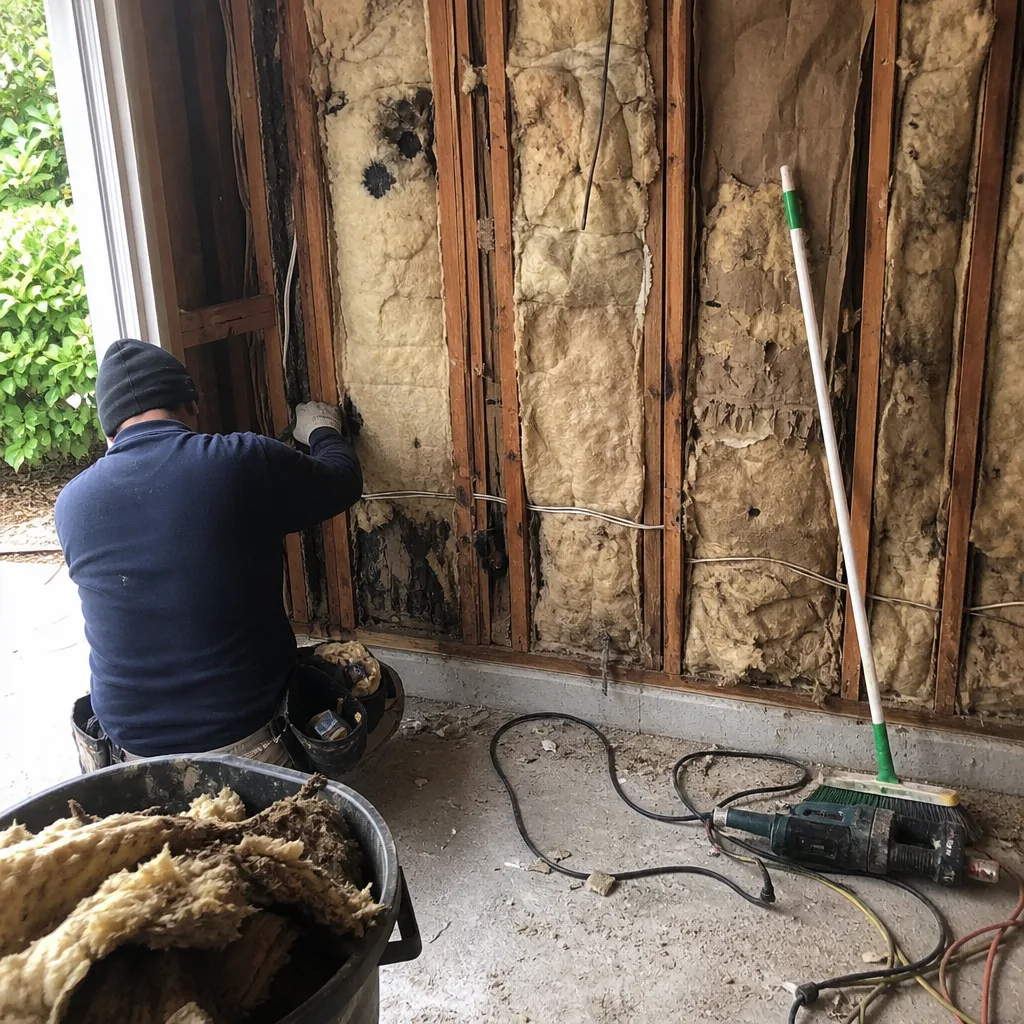 Before
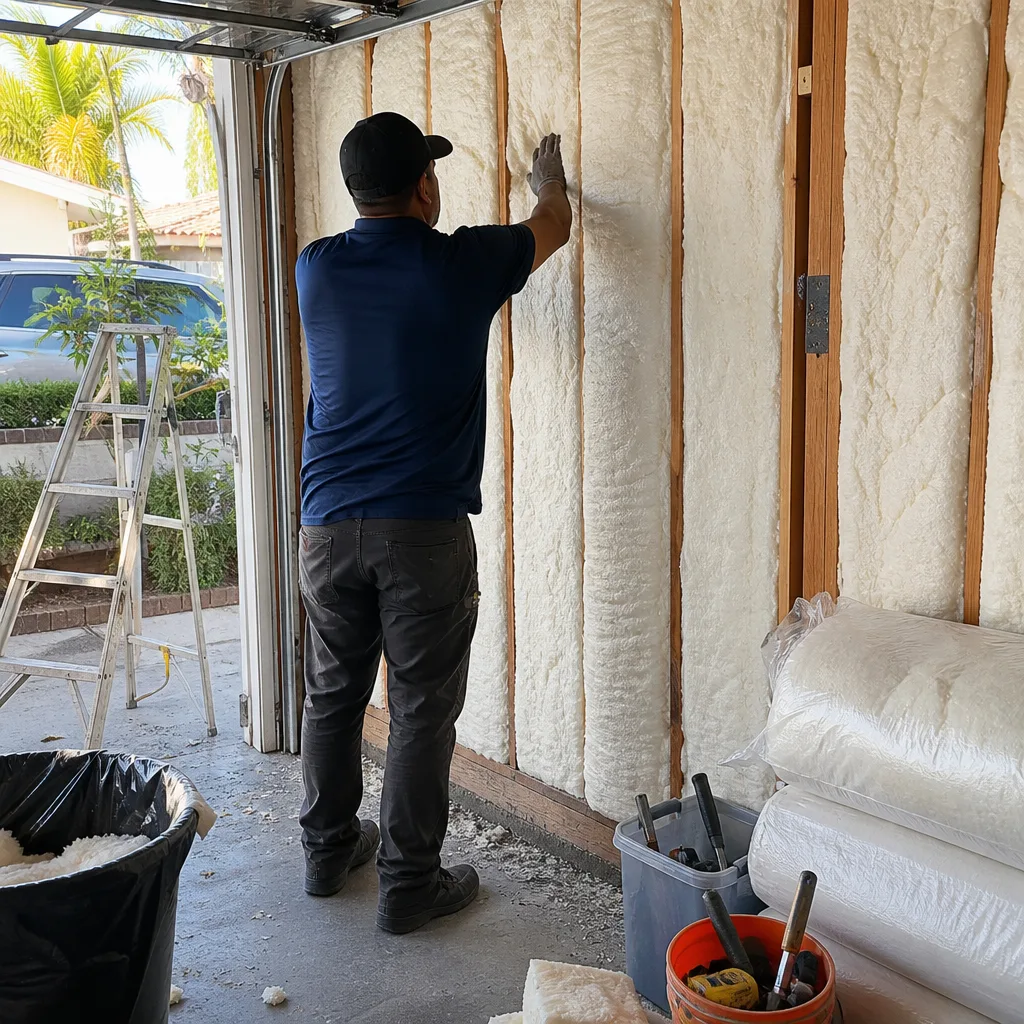 After
AfterHow to Measure Settled Depth and Calculate Actual R-Value
Every insulation job in Newport Beach should have left behind a Certificate of Insulation - a document that lists the installed density, the product name, and the target settled depth. If you don’t have this, call the original contractor. Without it, you’re guessing.
Here’s the problem: blown-in fiberglass and cellulose both settle after installation. Fiberglass settles less (roughly 1-2% over the first year), while cellulose can settle 10-15% or more if it wasn’t dense-packed. But in Newport Beach’s heat-cycling environment - 145°F attic days dropping to 55°F winter nights - the mechanical settling accelerates. We’ve pulled back insulation in Corona del Mar homes where the original 12-inch cellulose installation had compressed to 8 inches after seven years, dropping the effective R-value from R-38 to roughly R-25.
To check your settled depth:
- Wait for a cool morning, before the attic heats above 90°F. Bring a tape measure, a yardstick, and a camera.
- Locate the attic hatch and three additional points: one near the center of the attic, one near a gable end, and one near a valley or dormer where wind-driven rain might have pooled.
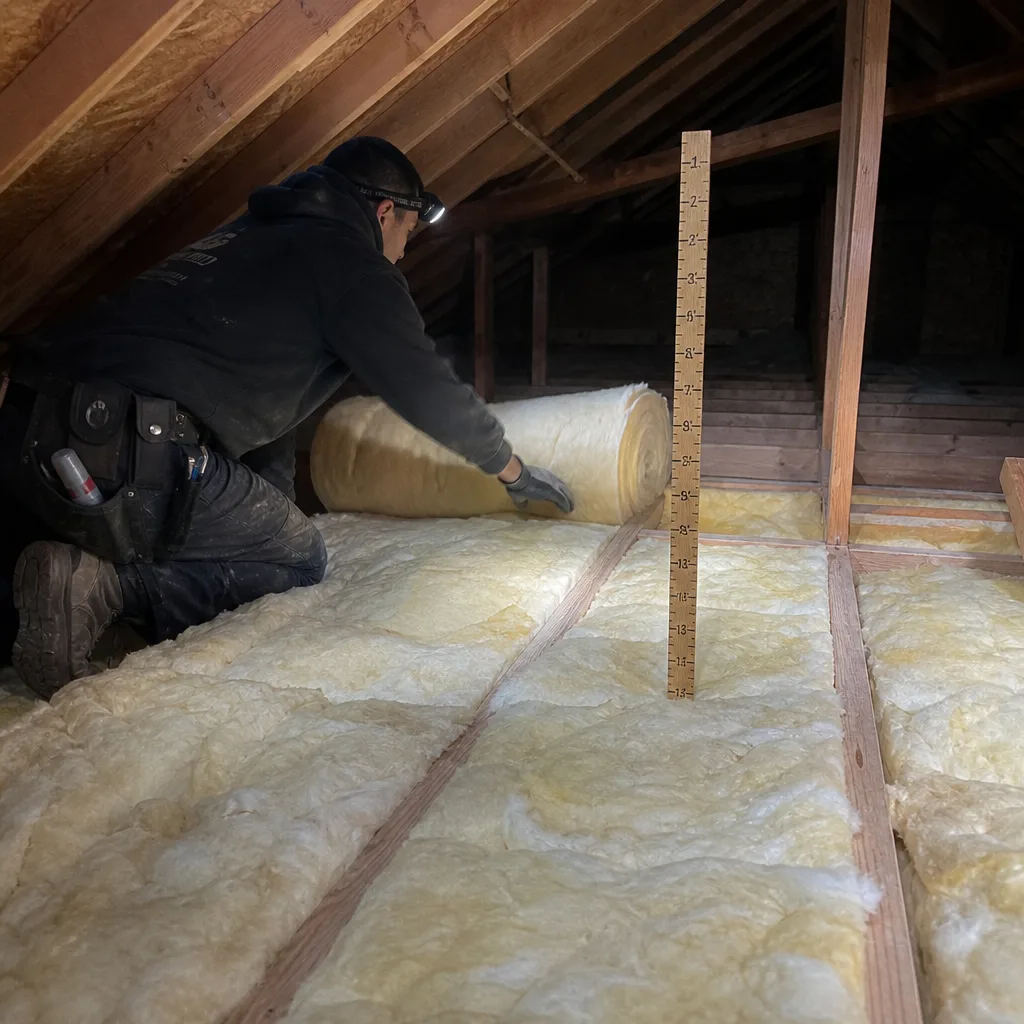
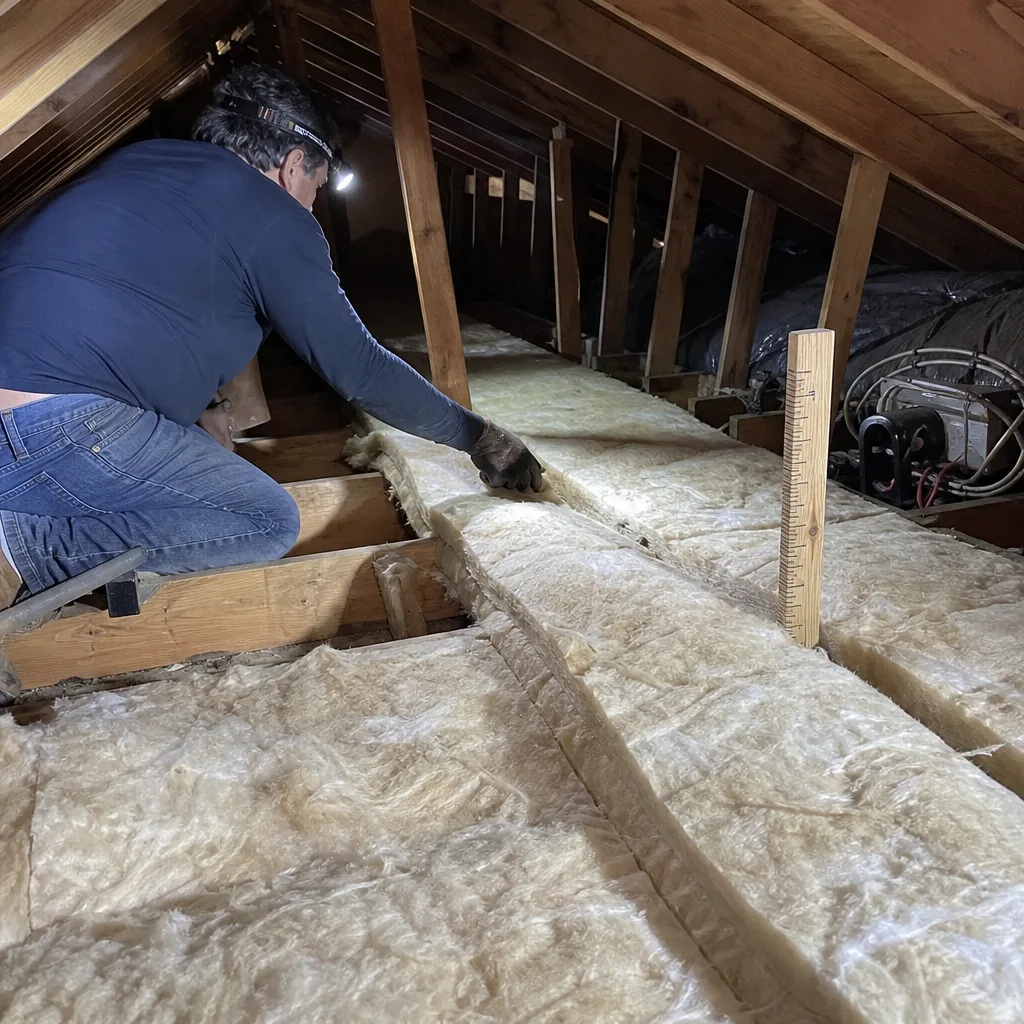
- At each point, gently sweep aside the top layer of insulation until you hit the drywall or the original attic floor. Measure vertically from the drywall to the top of the settled material. Record all four numbers.
- Compare your measurements to the installed depth on your Certificate of Insulation. If you don’t have the certificate, use the installed density to calculate: divide the settled depth by the original depth, then multiply by the labeled R-value.
- Look for variation. A 2-inch difference between your center measurement and your gable-end measurement usually indicates air movement - either a leak pulling insulation away, or inadequate ventilation creating a pressure differential.
The math matters. Owens Corning AttiCat blown fiberglass lists an installed density of 0.5 to 0.6 pounds per cubic foot. If your certificate shows 0.55 lb/ft³ and your settled depth reads 9 inches where 12 were installed, you’ve lost 25% of your thermal resistance. In a Newport Beach summer, that translates to higher ceiling surface temperatures, longer AC run times, and accelerated thermal bridging through the drywall.
We publish before-and-after blower-door numbers on every applicable job so homeowners can verify the air-sealing result in a single figure. A home that tests at 3,800 CFM50 before work and 2,200 CFM50 after has a measurable, documented envelope improvement. The depth measurement is your first indicator; the blower-door test is the confirmation.
Coastal Moisture Indicators Specific to Newport Beach Attics
Marine moisture in Newport Beach doesn’t announce itself with standing water. It accumulates through vapor diffusion, wind-driven mist, and the temperature differential between a 65°F marine layer morning and a 125°F roof deck by noon. The signs are subtle until they’re catastrophic.
Efflorescence on rafters. Look for white, crystalline deposits on the exposed faces of roof rafters, especially on north-facing slopes where the wood stays cooler longer. Efflorescence is mineral salt left behind when moisture evaporates through the wood. It means vapor is moving through the assembly, condensing on the cold wood surface, and drying repeatedly. In Newport Beach’s coastal environment, this cycle happens hundreds of times per year. The salts themselves aren’t structurally damaging, but they indicate that your attic’s vapor profile is uncontrolled. If you see efflorescence, check the insulation directly below: it’s likely damp or compressed.
Darkened cellulose channels. Cellulose insulation - made from treated paper - darkens when it wicks moisture. The darkening follows airflow paths, creating visible channels or streaks that point back to the leak source. In attics near Newport Harbor or along the Balboa Peninsula, we’ve seen darkened channels radiating from recessed can lights that weren’t properly sealed at the ceiling plane. The marine air finds every gap.
Condensation staining near soffit vents. Soffit vents are supposed to bring in dry outside air. In Newport Beach, they sometimes bring in fog-laden air during May Gray and June Gloom. When that humid air hits a roof deck that’s been cooling overnight, condensation forms on the underside of the sheathing and drips down onto the insulation below. The staining appears as gray or brown blotches on the insulation surface, concentrated in the first 12-18 inches inward from the soffit line.
What to do if you find these signs:
- Photograph everything before you disturb it. Documentation matters for insurance claims and contractor discussions.
- Check your bathroom exhaust fans, dryer vents, and kitchen range hoods. All three should terminate outside the building envelope, not into the attic. In Newport Beach’s humidity, dumping 2 gallons of moisture per shower into the attic is a guaranteed failure.
- Verify that your attic insulation isn’t blocking the soffit vents. Baffles - the cardboard or foam channels that keep insulation back from the vent opening - often collapse or get displaced during reroofing or pest activity.
If moisture indicators are present, insulation replacement without source correction is wasted money. The Haven Standard requires that we identify and document the moisture source before quoting any insulation work. Under Haven Standard: Have it in writing - the scope, the price, and the warranty before anyone lifts a tool.
Wildlife Intrusion Patterns and Air-Sealing Failures
Newport Beach’s coastal ecosystem produces specific wildlife pressure that inland Orange County doesn’t see at the same intensity. Roof rats travel along fence lines and tree canopies in the older neighborhoods of Lido Isle and Balboa Island, where mature landscaping creates continuous aerial highways. Birds - particularly house finches and English sparrows - nest in ridge vents and gable louvers year-round, not just in spring.
The damage pattern is predictable, but it’s rarely visible from the attic floor. Here’s what we find:
Roof rats compress insulation trails. Rats don’t eat fiberglass or cellulose, but they tunnel through it, creating compacted pathways that destroy the insulation’s loft and create thermal bypasses. A rat runway 6 inches wide running from a gable end to a chimney chase can drop the effective R-value across that path to near zero. The compressed insulation doesn’t recover when the rats leave.
Bird nesting blocks ventilation. A single finch nest in a ridge vent can reduce the net free area by 30-50%. Two nests, and the vent is functionally closed. In Newport Beach’s summer heat, that trapped hot air superheats the roof deck and radiates downward through the insulation. We’ve measured roof deck temperatures of 160°F in attics where ridge vents were 60% blocked.
Entry points that visual checks miss. Roof rats squeeze through gaps of ½ inch. Their common entry points in Newport Beach homes: gaps where the roof decking meets the fascia (especially on homes with clay tile roofs, where the irregular profile creates shadow gaps), penetrations for plumbing vents that weren’t sealed with fire-rated foam, and corners where two roof planes intersect. A visual inspection from the attic floor won’t show these. You need to trace the top plates with a flashlight, looking for daylight and disturbed insulation.
Inspection protocol:
- Start at the attic hatch and work clockwise. Look for insulation that appears “swept” or flattened in a directional pattern.
- Check all penetrations: plumbing vents, electrical runs, HVAC ducts, and chimney chases. Any gap larger than a dime is a potential entry point.
- Examine ridge vents and gable louvers from the inside. Look for nesting material, feathers, or droppings. Use your phone’s flashlight and camera; zoom in on suspect areas.
- If you find evidence, don’t seal the entry until the animals are excluded. Trapping and exclusion is a separate trade; we coordinate with licensed wildlife operators in Newport Beach before sealing any active entry.
After exclusion and sealing, we always verify with a blower-door test. A sealed attic should test tighter than it did before the wildlife damage. We publish those numbers so the homeowner can see the recovery.
Attic Ventilation Ratio: What It Means and How to Verify It
The building code calls for 1 square foot of net free vent area (NFVA) for every 150 square feet of attic floor space, or 1:300 if a vapor barrier is present and 50-60% of the ventilation is at the ridge. In Newport Beach, where summer radiant heat is the dominant load, we prefer the 1:150 ratio regardless of vapor barrier status. The attic needs to purge heat, not just manage moisture.
Net free area is the key term. A 16×8 inch gable louver might have a gross opening of 128 square inches, but the louvers, screen, and framing reduce the net free area to roughly 60-80 square inches. The manufacturer’s stamped NFVA rating is what counts, not the hole in the wall.
How to verify your ratio:
- Calculate your attic floor area in square feet. For a typical Newport Beach ranch of 2,000 square feet with a simple gable roof, that’s 2,000.
- Divide by 150. You need 13.3 square feet of NFVA total, with roughly 50% at the soffit and 50% at the ridge (or gable, if no ridge vent exists).
- Count your vents. Soffit vents are usually continuous strip vents or individual round vents. Strip vents list NFVA per linear foot; individual vents list it per unit. Ridge vents list NFVA per linear foot. Add them up.
- Check for blockage. In Newport Beach, we’ve found soffit vents painted shut, ridge vents covered during reroofing and never reopened, and gable louvers blocked by stored holiday decorations.
The reroofing risk is real. When a Newport Beach home gets a new tile or composition roof, the roofing crew often removes the old ridge vent to install new underlayment, then reinstalls it - or installs a different model with a different NFVA rating. We’ve seen homes where a 12 NFVA-per-foot ridge vent was replaced with a 9 NFVA model, dropping total ventilation by 25% without anyone documenting the change. After any reroof, verify the vent model and calculate the new ratio.
Blocked ventilation doesn’t just overheat the attic. It creates pressure imbalances that pull conditioned air upward through ceiling penetrations, increasing your cooling load and depositing moisture at the sheathing. In our Topside Attic Insulation Newport Beach home assessments, ventilation verification is standard on every inspection.
Twelve-Month Inspection Calendar for Newport Beach
Newport Beach’s climate has distinct seasons that trigger specific attic stressors. We’ve organized this calendar around the events that actually drive damage, not arbitrary quarterly dates.
January: Post-holiday hatch check. Attic hatches get opened in December for decoration retrieval. Check that the hatch gasket is intact, the pull-down stairs haven’t damaged the frame, and the insulation blanket on the hatch itself hasn’t been dislodged. A 2-square-foot uninsulated hatch in an R-38 attic is equivalent to a 6-inch diameter hole in your ceiling, open year-round.
February-March: Post-Santa Ana inspection. Santa Ana winds peak in December and January, but the damage shows up by February. Check for wind-lifted ridge vent sections, displaced gable louvers, and debris infiltration through soffit vents. The dry, high-velocity Santa Ana air also dessicates wood and can crack old mastic seals around penetrations.
April: Pre-cooling-season depth verification. Before you start running AC in earnest, verify settled depth at four points. If you’re down more than 15% from installed depth, schedule replenishment before the summer heat load peaks. See The Complete Guide to Insulation in Newport Beach for full material comparisons.
May-June: Marine layer moisture scan. May Gray and June Gloom bring the highest relative humidity of the year. This is when condensation staining near soffits appears, and when efflorescence on north-facing rafters is most visible. Run your moisture inspection now, while the evidence is fresh.
July-August: Peak heat thermal check. If you’ve ever wanted to justify a thermal camera rental, this is the month. Scan your ceiling from the living space on a 90°F+ afternoon. Hot spots indicate insulation gaps, compression, or air leakage. Document with photos; compare to a winter scan if you have one.
September: Wildlife exclusion verification. Rat activity peaks in late summer as juveniles disperse. Check for new entry points, disturbed insulation, and fresh droppings. If you had exclusion work done in spring, verify the seals are holding.
October: Pre-winter ventilation confirmation. Before the occasional winter rain arrives, verify that all vents are clear, screens are intact, and no reroofing debris is blocking soffit channels. October is also ideal for blower-door testing; the mild outside temperature reduces test variability.
November-December: Holiday decoration protocol. If you store decorations in the attic, use plastic bins, not cardboard (rodent attractant). Never stack bins on top of insulation; they compress it permanently. Build a simple storage platform over the joists, or use the garage instead.
When Thermal Scanning and Blower-Door Testing Are Worth It
Visual inspection catches the obvious. Thermal scanning and blower-door testing catch what visual inspection cannot. Browse our more guides & resources for additional inspection techniques.
A thermal camera - even a $400 FLIR attachment for your phone - reveals temperature differentials across the ceiling plane. In a Newport Beach attic, we look for:
- Insulation voids above top plates, where blown material missed the narrow cavity
- Thermal bridging through steel ductwork or recessed light housings
- Air leakage paths around chimney chases and plumbing stacks
- Moisture saturation in cellulose, which changes the thermal signature
The blower-door test is more definitive. It’s a pressurization reading that shows, in one number, how much air your building envelope is losing. We run the fan to depressurize the house to 50 Pascals, then measure the airflow in cubic feet per minute (CFM50). A typical 2,000-square-foot Newport Beach home from the 1970s might test at 4,500 CFM50. After air sealing and insulation, we target 2,500 or below.
The value of the blower-door test isn’t just the number. It’s the diagnostic capability. With the house under depressurization, we walk the attic with a smoke pencil and find every leak that’s actively pulling conditioned air upward. In Newport Beach’s cooling-dominated climate, that’s money leaving your wallet in real time.
We publish before-and-after blower-door numbers on every applicable job. Homeowners receive the documentation: the initial reading, the final reading, the photo record of sealed locations, and the written scope that defines what was done. Under Haven Standard: Have it in writing.
For homeowners considering spray foam insulation in Newport Beach, the blower-door test is especially critical. Spray foam creates an air barrier and insulation in one step, but only if it’s applied at the correct thickness and density. A post-installation blower-door test verifies that the air barrier is complete, not just thick.
Material-Specific Maintenance: Fiberglass, Cellulose, and Spray Foam
Different insulation materials fail differently in Newport Beach’s climate. The inspection items vary.
Blown fiberglass (Owens Corning AttiCat, Johns Manville Spider, Knauf Jet Stream). The primary failure mode is convective looping in extreme heat. At attic temperatures above 130°F, the low density of blown fiberglass allows air to circulate within the insulation itself, carrying heat from the roof deck down to the ceiling. The labeled R-value assumes no air movement; the actual performance can drop 20-25%. Maintenance focus: verify density hasn’t decreased due to disturbance or settling, and consider a radiant barrier or dense-pack upgrade if your attic regularly exceeds 140°F.
Cellulose (GreenFiber, CertainTeed InsulSafe). Cellulose is denser and more resistant to convective looping, but it’s hygroscopic - it absorbs moisture from the air. In Newport Beach’s marine environment, cellulose that gets damp stays damp longer than fiberglass. Maintenance focus: moisture indicators are critical. Darkened, clumped, or odor-present cellulose needs removal, not just topping. We’ve replaced cellulose in Newport Beach attics where the moisture content reached 18-20% by weight; at that level, mold risk is elevated and the R-value has dropped measurably.
Spray foam (Icynene, Demilec, closed-cell and open-cell). Spray foam doesn’t settle, doesn’t loop, and doesn’t absorb moisture. The maintenance items are different: check for UV degradation on any exposed surfaces (foam degrades in sunlight), verify that the foam hasn’t pulled away from framing members due to thermal cycling, and inspect the ignition barrier or thermal barrier coating for damage. In Newport Beach, we see more open-cell foam installations in recent years; open-cell is vapor-permeable, so the moisture management strategy must be deliberate, not accidental.
Mineral wool (Rockwool Comfortbatt, Roxul). Less common in attics but growing in popularity for its fire resistance and sound attenuation. Mineral wool is hydrophobic and doesn’t support mold growth, making it attractive for coastal applications. Maintenance focus: verify that batts haven’t slipped out of place in steep-slope attics, and check for compression from storage or foot traffic.
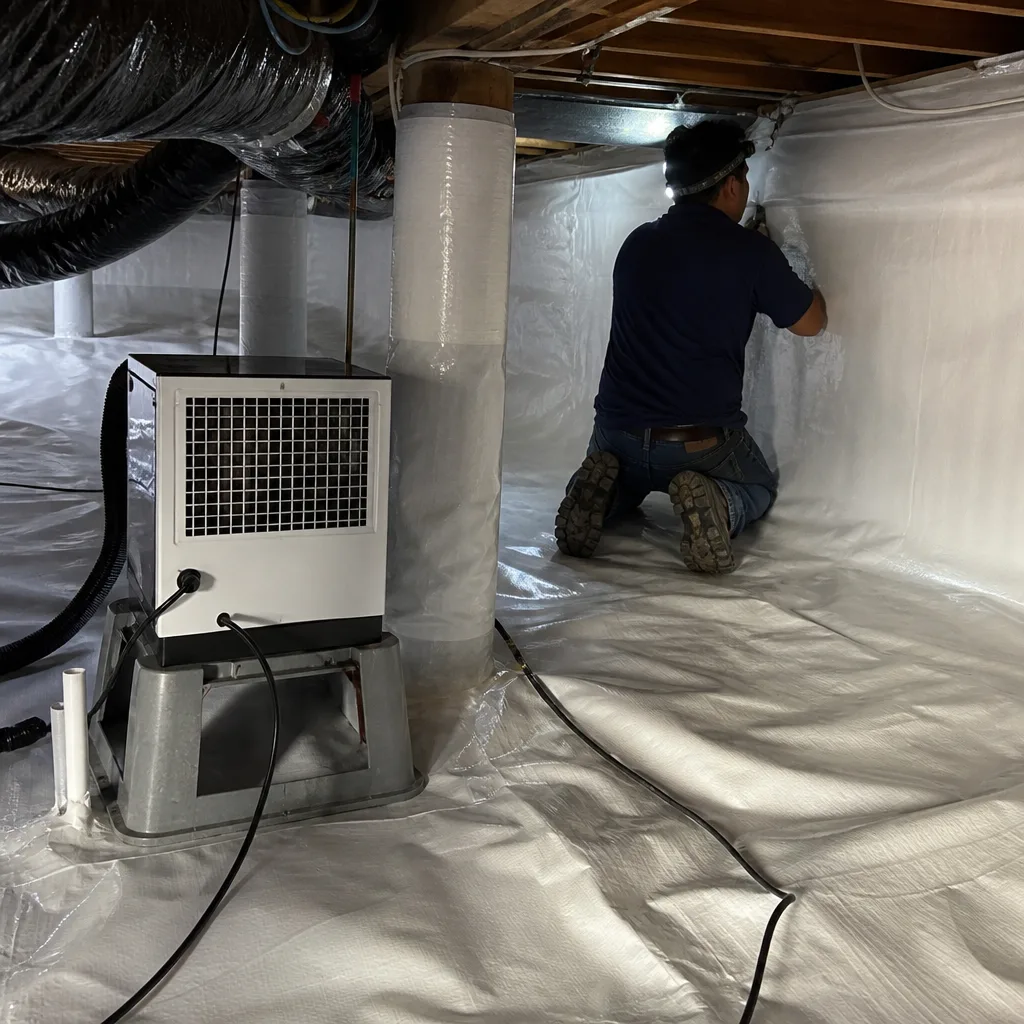
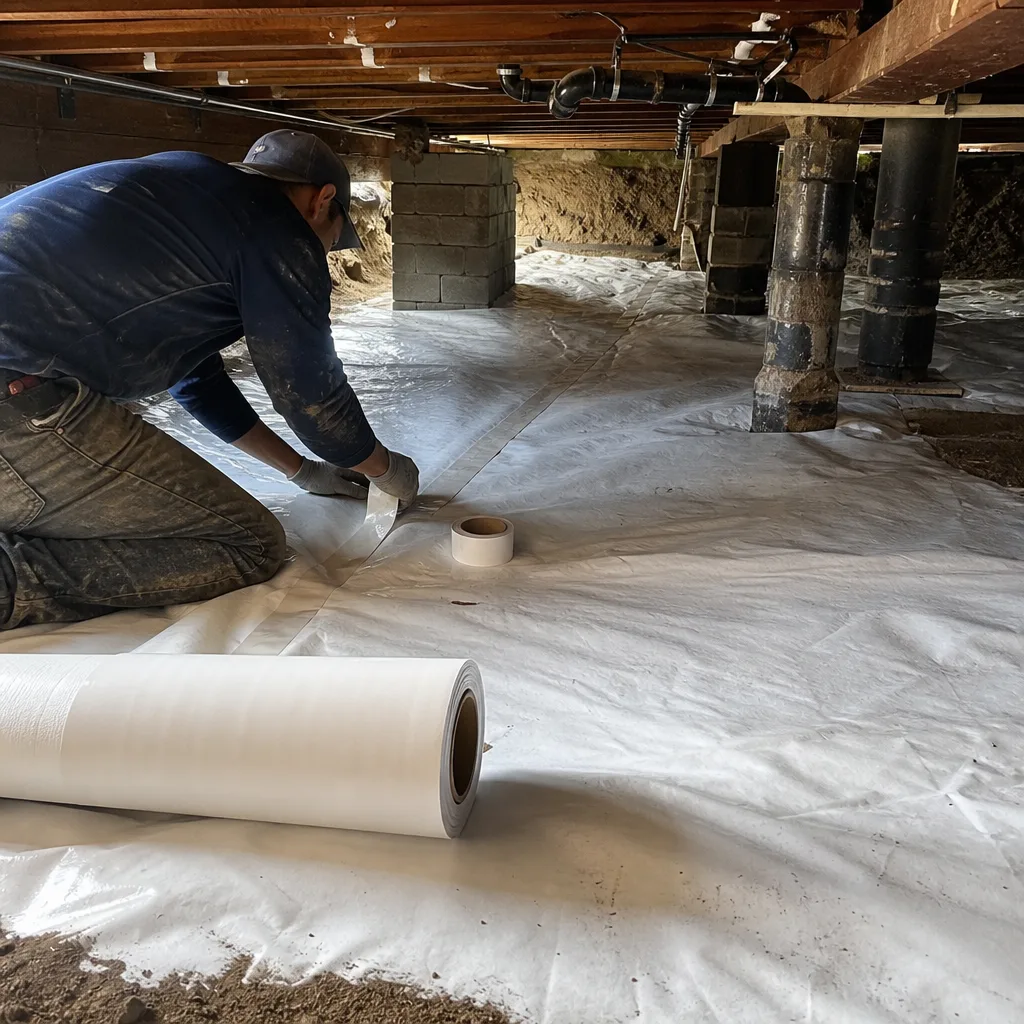
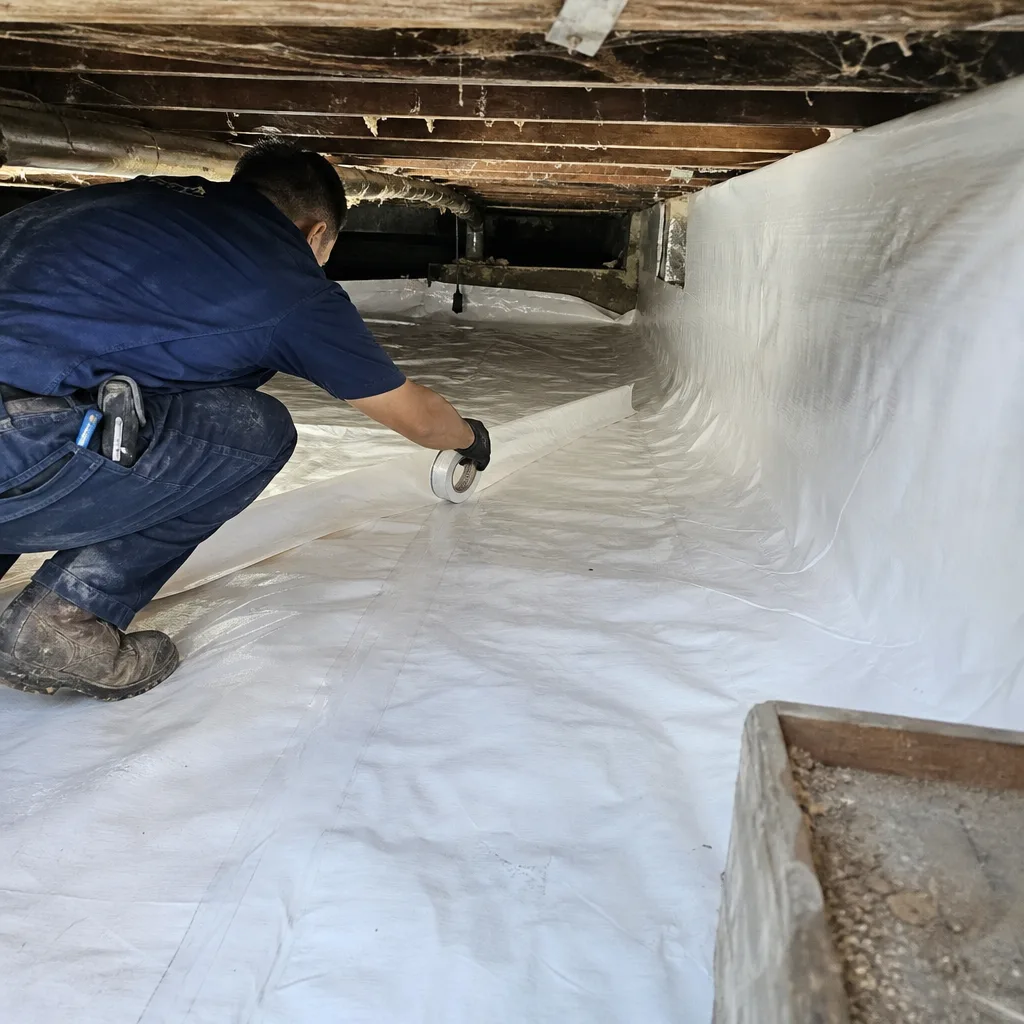
For homes with crawl space encapsulation and vapor barrier in Newport Beach, the same material-specific logic applies. The crawl space is part of the building envelope, and its insulation condition affects the whole-house performance.
Common Mistakes to Avoid
- Adding insulation over unsealed air leaks. Blowing new fiberglass over a leaky attic floor is like putting a thicker sweater on a screen door. The conditioned air escapes through the gaps, and the new insulation becomes a filter for dust and moisture. We see this constantly in Newport Beach homes where a previous contractor “topped off” the insulation without addressing the top plates, can lights, or duct boots.
- Compressing insulation with storage or walkways. Every footstep on blown insulation crushes the loft permanently. A 12-inch depth compressed to 6 inches loses half its R-value in that footprint. Build storage platforms or use the garage.
- Blocking soffit vents with insulation during a DIY top-off. Homeowners add insulation, push it to the eaves, and accidentally cover the vents. Within two years, the attic is overheating and the moisture profile is ruined. Baffles exist for a reason; don’t remove them.
- Ignoring the hatch. The attic hatch is the most frequently opened, least frequently sealed component. A weatherstripped, insulated hatch with latch hardware costs under $100 in materials and saves more than most people expect.
- Assuming reroofing didn’t affect ventilation. Roofing crews focus on the roof, not the attic system. Vents get covered, replaced with lower-NFVA models, or reinstalled with gaps. Always verify after any roof work.
- Treating all insulation as interchangeable. Fiberglass, cellulose, and spray foam have different failure modes and different maintenance requirements. Know what you have before you inspect.
- Skipping documentation. Photograph your attic condition annually. When something changes - a dark streak, a compressed path, a new gap - you’ll have evidence of when it started. This matters for warranty claims, insurance disputes, and contractor accountability.
When to Call a Professional
Some attic conditions are beyond homeowner inspection. Call a professional when you find moisture indicators that suggest active leakage, wildlife evidence that requires exclusion before sealing, or settled depth that has dropped more than 20% from installed depth. Call when your summer cooling bills have risen without explanation, or when a thermal scan from the living space shows persistent hot spots above 10°F differential.
Call when you’re considering adding insulation, because the addition must be compatible with the existing material and the attic must be sealed first. Attic insulation in Newport Beach requires specific knowledge of coastal moisture, ventilation ratios, and the interaction between radiant heat and convective looping.
Topside Attic Insulation Newport Beach offers free estimates in Newport Beach - call (657) 261-8265. Every estimate includes a written price before any work starts, a documented photo record, and on applicable jobs, before-and-after blower-door numbers so you can verify the result. The 365-Day Done Right Promise applies to all completed work. Under Haven Standard: Have it in writing.
Frequently Asked Questions
Perform a visual inspection twice yearly - once in April before cooling season, and once in October before any winter rain. Verify settled depth annually in April. Schedule professional blower-door testing every 3-5 years, or after any reroofing, major HVAC work, or wildlife exclusion. Call (657) 261-8265 to schedule a documented inspection with before-and-after numbers.
California Title 24 calls for R-38 minimum in Climate Zone 7, which includes Newport Beach. However, given our extreme summer radiant heat loads, we often recommend R-49 for homes with dark composition roofs or limited ventilation. The key is actual in-place R-value, not labeled R-value; a poorly installed R-49 performs below a well-installed R-38 with complete air sealing. We verify with depth measurement and blower-door testing, not assumptions.
Only if the old insulation is dry, uncompressed, and free of pest debris - and only after air sealing is complete. In Newport Beach, we frequently find that “topping off” is the wrong approach because the existing material is moisture-compromised or the attic floor was never sealed. We assess the existing insulation’s condition before recommending any addition. Under Haven Standard: the scope is written, the price is fixed, and the warranty is delivered before work starts.
Most attic insulation jobs in a Newport Beach home of 2,000-2,500 square feet run between $2,800 and $5,500 for air sealing and blown-in fiberglass or cellulose replacement, including removal of compromised material. Spray foam applications range higher, typically $4,500-$8,500 depending on access and square footage. These ranges include the written scope, documented photo record, and on applicable jobs, before-and-after blower-door readings. For an exact quote on your specific attic, call (657) 261-8265 - estimates are free, and we provide a Free Second Opinion on any written estimate you’ve already received.
Three common causes in Newport Beach: convective looping in low-density fiberglass at high attic temperatures, air leakage through unsealed penetrations that bypasses the insulation entirely, or blocked ventilation that traps superheated air. We’ve measured attic air temperatures of 155°F in homes with R-38 insulation where the ventilation was 60% blocked and the top plates were unsealed. The insulation was doing almost nothing. A blower-door test with attic depressurization finds the real problem in under an hour.
Yes, indirectly. Compromised attic insulation allows attic air - which in Newport Beach can contain dust, fiberglass fragments, rodent debris, and moisture-borne contaminants - to migrate into conditioned space through ceiling penetrations. Properly sealed and insulated attics with adequate ventilation maintain a separation between attic and living space. If you or a family member has unexplained respiratory symptoms that worsen in summer, the attic envelope is worth inspecting. We include indoor air quality impact in our assessment documentation.
The Bottom Line
Newport Beach attics demand a maintenance approach calibrated to coastal heat, marine moisture, and wildlife pressure - not a generic cold-climate checklist. Measure settled depth against your Certificate of Insulation. Scan for efflorescence, darkened cellulose, and condensation staining. Verify ventilation ratios after any roof work. Time your inspections to the Santa Ana season, the marine layer peak, and your own holiday decoration cycles. Document everything. And when the condition exceeds what a homeowner can verify, demand documented evidence from any contractor you hire: written scope, written price, photo record, and blower-door numbers that prove the result.
Written by Wes Okafor, Owner at Topside Attic Insulation Newport Beach, serving Newport Beach since 2016.